How to Get Involved in Local Politics: 6 Ways to Start
10 min
Published: May 14th, 2026
Table of contents
Start by Showing Up
Volunteer on a Campaign
Join or Build a Democratic Club or Organization
Attend Public Meetings and Speak Up
Get Trained to Organize and Lead
Run for Office Yourself
How NDTC Helps Democrats Engage at Every Level
Most people who care deeply about politics spend the vast majority of their energy as spectators: following national news cycles, tracking federal legislation, debating what's happening in Washington. And while that level of engagement matters, it often distracts from the fact that political decisions that most directly shape your daily life are rarely made in Washington. They're made down the street.
City councils control housing and public safety budgets. State legislators draw congressional maps, determine Medicaid eligibility, and set the rules for how elections are run. Local school boards set the curriculum. That’s why asking how to get involved in local politics is one of the most consequential questions any Democrat can pose right now. The work of building and holding Democratic power that’s durable and long-lasting happens at this level first.
The good news? You don't need a political science degree, a family name, or a big bank account to get involved locally. You just need to know where to begin.
1. Start by Showing Up
Before strategy, before training, before anything else: just show up.
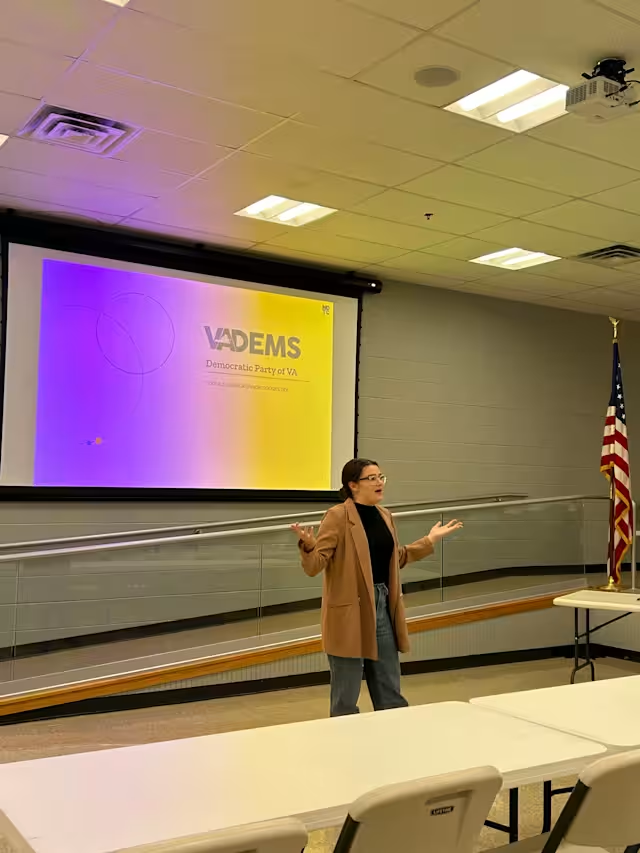
Attend a city council meeting, go to a school board session, or walk into a county Democratic Party meeting. These are public spaces where decisions get made and where the people making those decisions notice who is and isn't present.
First-time attendees are often surprised by how accessible local government is. Meetings happen in community centers, school auditoriums, and city hall conference rooms. The officials present are your neighbors. The agenda is public. The comment period is open. Showing up consistently, even without saying a word at first, signals to decision-makers and organizers alike that you're engaged and that you intend to stay that way.
Think of the bodies that govern your community: city council, school board, planning commission, water board, library board, and county commission. Find their meeting schedules and commit to attending at least one a month. That habit alone puts you ahead of the vast majority of residents and gives you firsthand knowledge of what's happening and where Democrats need to push.
2. Volunteer on a Campaign
Campaigns from school board to state legislature run on volunteer power. If you want to understand how political change actually gets made, there is no better education than working inside a campaign.
Campaign volunteering is available to anyone, requires no prior experience, and directly shapes electoral outcomes. In tight local races, a handful of organized volunteers knocking doors and making phone calls can be the difference between a win and a loss. Your time is a resource that every down-ballot campaign needs, and that money alone cannot replicate.
Reach out to your local or state Democratic Party to find out which campaigns in your area need support. Show up to a volunteer orientation. Say yes to canvassing. Take on a shift lead role when it's offered. Each level of responsibility you take on teaches you something about how campaigns work, and positions you for other roles in future cycles.
NDTC offers free resources for campaign volunteers that cover canvassing, phone banking, messaging, fundraising, and more. Getting trained before you show up to a campaign makes you more effective from day one, and the campaign staff will take notice.
3. Join or Build a Democratic Club or Organization
Beyond campaigns, the infrastructure of Democratic politics lives in its clubs, caucuses, and issue-based organizations. These are the spaces where candidates are recruited, endorsements are secured, volunteer networks are built, and the ongoing work of party organizing gets done.
Most communities have at least one active Democratic club. Many have several organized by geography, identity, issue focus, or affiliation with a specific caucus within the broader party. Find the organizations active in your community and join one. Show up regularly and volunteer for their events. Over time, take on leadership roles.
If your community doesn't have an active Democratic organization, that gap itself is an opportunity. Starting a club or organizing committee requires no formal authority — just a group of committed people willing to meet consistently and do the work. The Democratic Party at the state and local level can often provide guidance, resources, and visibility for new organizing efforts, so lean on that support.
4. Attend Public Meetings and Speak Up
Attending meetings is a great start, but speaking up at them is how you become a force.
Public comment periods exist specifically to let residents shape policy decisions before they're finalized. Planning decisions, budget allocations, school policies, and zoning changes all go through public processes in which community input is formally solicited and sometimes genuinely moves outcomes.
Learning to speak at public meetings is a skill, and like all skills, it improves with practice. Keep your comments focused and specific. Speak to the decision-makers, not the audience. Tie your position to a concrete community interest. And remember that officials notice the residents who appear consistently, and your presence will build credibility over time.
If public speaking feels intimidating, start small. You can write a letter to the editor of your local paper, submit a formal public comment in writing on a pending decision, or sign up to testify with a brief comment. Each of these actions contributes to the public record and signals to elected officials that their decisions are being watched.
5. Get Trained to Organize and Lead
Understanding how to get involved in local politics is one thing. Knowing how to do it effectively — how to recruit and coordinate volunteers, how to communicate a message that moves people, how to build the kind of lasting community relationships that sustain a political movement across multiple cycles — is a learnable skill set.
This is where formal training pays off in ways that pure enthusiasm cannot. Democrats who get trained in organizing fundamentals, campaign strategy, and political communication are more effective. They make fewer mistakes, build stronger teams, and deliver better results across volunteer groups, local clubs, and campaigns.
NDTC has trained over 130,000 Democrats since 2016, including candidates, campaign staff, and community organizers at every level of the ballot. Every course and resource is free and developed by industry experts. If you're serious about learning how to get involved in local politics in an impactful way, starting with NDTC's trainings is one of the highest-leverage steps you can take.
6. Run for Office Yourself
Showing up, volunteering, organizing, attending meetings, and getting professional-grade training eventually raises the same question for a lot of engaged Democrats: Why not me?
And there really is no good answer. The most common barrier to running for office isn't a lack of qualification, but a lack of confidence. The assumption that you're not the “right type” of personality, don't have the right background, or can’t do it now, just because you haven't done it before. Those assumptions are wrong, and every cycle they go unchallenged, Democrats are leaving talent and untapped potential on the table.
Some of the most effective Democratic elected officials in America had no prior political experience before their first campaign. Rep. Lauren Underwood was a nurse when she trained with NDTC and ran for Congress. Rep. Maxwell Frost became the first Gen Z member of Congress ever elected after starting with NDTC. They shared deep community roots, a clear vision, and the preparation to run a competitive campaign.
NDTC's free trainings walk first-time candidates through every phase of a campaign, from filing paperwork and building a team to fundraising, voter contact, and Election Day execution. Whether you're eyeing a school board seat or a state legislative race, the fundamentals NDTC teaches are practical, proven, and built specifically for Democrats at every level of the ballot.
How NDTC Helps Democrats Engage at Every Level
Getting involved in local politics is a practice that deepens over time, from your first city council meeting to your first campaign volunteer shift to, for many people, their first time on a ballot. NDTC is built to support Democrats at every stage of that journey.
Through free online trainings, on-demand resources, and a comprehensive curriculum that covers organizing, campaigning, fundraising, and leadership, NDTC gives every Democrat the preparation they need to make an impact in their community.
The democratic bench doesn't build itself. It gets built by people who showed up, got the right training, and stayed committed to the work. That can be you.
Sign up for NDTC's free trainings today and take your first step toward real political impact.


