What Is Phone Banking? Democrats’ Cheat Sheet to Running Effective Phone Banks
12 min
Published: May 20th, 2026
Table of contents
What Is Phone Banking? And Why Does It Still Work?
How Phone Banking Fits Into Your Campaign's Voter Contact Strategy
How to Phone Bank: A Step-by-Step Guide
Common Phone Banking Mistakes (and How to Avoid Them)
Training Your Volunteers to Phone Bank Effectively
How NDTC Prepares Democratic Campaigns to Phone Bank and Win
What Is Phone Banking? And Why Does It Still Work?
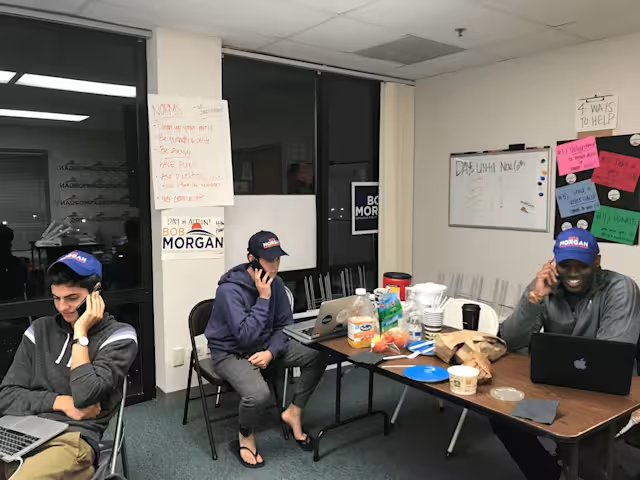
What is phone banking? At its core, phone banking is the organized practice of making outreach calls to voters on behalf of a candidate or campaign. Volunteers or staff work through a list of targeted voters, typically pulled from the campaign's voter file, and make calls to persuade, identify supporters, or mobilize people to turn out and vote.
It's one of the oldest tools in political organizing. And it works. Research consistently shows that high-quality phone contact, especially from volunteers who are genuine community members rather than robocalls, meaningfully moves voter behavior. An early aughts analysis of randomized controlled trials found that volunteer phone banking is one of the most cost-effective methods of increasing voter turnout. A well-run program produces measurable lifts in both persuasion and mobilization.
But what is phone banking in the context of modern campaigns? It has evolved with technology. Modern phone banking operations use digital dialers, call scripts integrated with voter data, and real-time tracking tools that allow campaigns to monitor contact rates and results as they happen. But the core of it remains: a team member having a live conversation with a voter. That personal touch is how it has stayed effective for decades.
How Phone Banking Fits Into Your Campaign's Voter Contact Strategy
Phone banking isn’t meant to replace your canvassing operation. They should complement each other and work together to meet your goals.
Door-to-door canvassing reaches voters who are home and answer the door, but misses those who aren't there or unwilling to answer to a stranger. Phone banking catches voters who didn't open the door on Saturday morning but will pick up a call on a weekday evening. Together, they give campaigns multiple points of contact with the same voter. Evidence from more than 200 GOTV experiments found that door-to-door canvassing increases turnout by about 1 percentage point and phone calls by 0.4 points, meaning a campaign that uses both can stack their results.
Phone banking is also an essential tool for reaching voters who are geographically difficult to reach in person. Rural voters spread across large distances, and apartment or nursing home residents in buildings with restricted access can be more reliably reached by phone than on foot.
For campaigns running on lean budgets, phone banking is particularly powerful because the marginal cost is low. Once your volunteers are trained and your call lists are pulled, the cost per conversation is very little. That efficiency makes it an indispensable part of any competitive Democratic campaign.
How to Phone Bank: A Step-by-Step Guide
Understanding what phone banking is in theory is one thing. Knowing how to run a phone bank is another. Here is a step-by-step breakdown of how to build and execute an effective phone banking program.
Step 1: Define your universe.
Before anyone picks up a phone, your campaign needs to know who you're calling and why. Your voter file (available through your state or local Democratic Party) contains contact information and voting history for registered voters in your district. Work with your campaign manager or data director to pull a targeted call list based on your goals.
Are you trying to:
Identify supporters you can bank on?
Remind low-propensity Democrats to request a mail ballot or get to the polls?
Your universe and your script will look different depending on which goal you're pursuing. Calling the right voters with a prepared message saves volunteer time and produces cleaner data.
Step 2: Write a clear, conversational script.
A phone banking script is not a speech. It is a guide for conversations. The best scripts are brief, plainspoken, and designed to feel natural. Voters on the other end of the line shouldn’t feel like they’re talking to a robot.
A well-structured script typically includes:
A brief, friendly introduction identifying the caller and the candidate
A clear purpose for the call (gathering a voter ID, sharing information, making a GOTV ask)
One or two open-ended questions to engage the voter
A clear closing ask, whether that's confirming support, providing a polling location, or encouraging an early vote
A polite, professional close regardless of how the conversation goes
Write your script with your volunteers in mind. If it sounds awkward when read aloud, revise it until it doesn't. Train your volunteers to internalize the message rather than read word-for-word. Voters will feel the difference.
Step 3: Set up your tools.
Modern phone banking programs run on digital platforms that integrate call lists with data tracking. Tools like ThruTalk, NGPVAN, or MiniVAN allow volunteers to call through lists, log responses in real time, and give campaigns instant visibility into how the program is performing.
If you're running a very small operation, phone banking can be done with a simple spreadsheet and a personal phone. But as your program scales, investing in proper tools pays off in efficiency and data quality. Check with your state or local Democratic Party. In many cases, these tools are available to Democratic campaigns at reduced or no cost.
Step 4: Train your volunteers before they dial.
This is the step most campaigns shortchange, and it shows in their results. Volunteers who drop into phone banks with proper training make calls sound natural, record data correctly, and have easier conversations with voters.
A good phone banking training should cover:
The purpose of the calls and what a successful interaction looks like
How to use the calling platform and log responses correctly
How to deliver the script in a natural, conversational way
How to handle common scenarios: voicemails, hostile voters, voters with questions the volunteer can't answer
When to end a call and move on
Training doesn't have to take long. Even thirty minutes of preparation before a shift makes a significant difference in call quality and volunteer confidence.
Step 5: Run the shift.
A well-run phone bank shift has structure. Start with a brief team check-in, walk through the script together, answer any last questions, and then get on the phones. Have a shift lead or staff member circulating to answer questions in real time, monitor call quality, and keep energy up.
Aim for shifts of two to three hours. They’re long enough to be productive, short enough that volunteers stay energized and don't burn out. Wrap up every shift with a brief debrief: how did calls go, what questions came up frequently, what's the data showing?
Step 6: Track, review, and improve.
The value of phone banking isn't just in the individual conversations, but the data those conversations generate. Every call should be logged with a voter response (supporter ID, persuasion result, or refusal). That data updates your voter file, shapes future targeting decisions, and tells your campaign whether the program is on track.
Review your contact rates and response data after every shift. If you're reaching a low percentage of the voters on your list, troubleshoot why. It could point to bad numbers, calling at the wrong time of day, or a universe that needs to be scrubbed. If a particular message is landing well or generating pushback, update the script. Continuous improvement is what separates a phone banking program that produces results from one that just produces activity.
Common Phone Banking Mistakes (and How to Avoid Them)
Even well-intentioned phone banking programs make predictable mistakes. Here are four major ones to watch out for:
Calling the wrong voters. A poorly pulled call list wastes everyone's time. Make sure your universe is targeted and current before your first shift.
Using a script that sounds like a script. Robotic delivery loses voters immediately. Train your volunteers to own the message, not recite it.
Skipping data entry. Calls without logged results are calls that didn't happen as far as your campaign is concerned. Build data discipline into your training from day one.
Burning out volunteers. Grueling multi-hour shifts with no support or energy management produce diminishing returns. Keep shifts focused, keep morale up, and make sure volunteers feel like what they're doing matters. Because it does.
Training Your Volunteers to Phone Bank Effectively
What is phone banking without well-prepared volunteers? Not very effective. Volunteer training is where phone banking programs fly or fall apart.
The best phone banking volunteers are community members who care about the candidate and the issues, who know enough to have a genuine conversation, and who are prepared enough to handle the unexpected with confidence and grace. That preparation is teachable.
NDTC's training resources cover phone banking fundamentals as part of our broader field and voter contact curriculum. Whether your volunteers are brand new to campaign work or returning for another cycle, the right preparation makes them more effective on day one and more confident as the program builds toward Election Day.
How NDTC Prepares Democratic Campaigns to Phone Bank and Win
Understanding what phone banking is and knowing how to run it well are two different things. NDTC's free online trainings and on-demand resources give Democratic candidates, campaign staff, and volunteers the practical foundation to build voter contact programs that actually deliver. From writing an effective call script to training a volunteer team to tracking data and improving in real time, NDTC's curriculum walks you through every stage of a competitive phone banking operation.
We've helped train over 130,000 candidates, staff, and volunteers since our launch. Behind every one of our victories was a voter contact program built by people who showed up prepared, got their volunteers trained, and made the calls that moved the race.
Your campaign's phone banking program starts with one trained volunteer, one good script, and one conversation with a voter who needs to hear from you. NDTC is here to make sure you know how to build from there.
Sign up for NDTC's free trainings today and start building the phone banking program your campaign needs to win.

